type Option Option: 枚举类型,处理缺失值的核心, 取代 null
enum Option <T> { Some (T), None , }
Some(T):代表“有值”。T 是具体的数据类型(比如 i32、String 等)
生命周期 静态生命周期 'static #![allow(unused)] fn main () {let s : &'static str = "hello" ; static GREETING: &str = "hello" ;fn spawn <F: FnOnce () + Send + 'static >(f: F) { }}
静态字符串字面量 &'static str 在代码中直接写出的字符串字面量(如 “hello”)是硬编码在二进制文件里的。
存储位置: 存储在编译后可执行文件的只读数据段 (Read-only Data Segment) 中。
生命周期: 当程序加载到内存中时,这些数据就已经存在了,直到程序结束才会被释放。因此,不需要在堆上分配空间,也不需要手动释放。
结论: 所有的字符串字面量默认都是 'static 的。这意味着你可以将它们传递给任何要求 'static 生命周期的地方,编译器会允许这种引用。
静态变量 static 使用 static 关键字定义的变量与字符串字面量类似。
static GREETING: &str = "hello" ;
全局可见性: static 变量是全局的,它们在内存中拥有固定的地址。
线程安全: 由于 static 变量是全局的,如果它们是可变的(static mut),多个线程同时修改它们会导致数据竞争。因此,Rust 默认要求 static 变量必须满足 Sync trait(即在多线程间共享是安全的)。
生命周期: 它们在程序的整个运行期间都保持有效。
Trait Bound (特征约束)中的 'static 在函数签名中出现 ‘static 时,意义发生了变化,不再仅仅指”存在于二进制文件中的数”。
fn spawn <F: FnOnce () + Send + 'static >(f: F)
当 'static 用于 Trait Bound(例如 T: 'static)时,它的意思是:”类型 T 中包含的所有引用,其生命周期必须至少是 'static 的”
满足该'static
不捕获任何引用: 如果闭包内部没有使用任何外部变量,它是 'static 的
使用 move 关键字: 通过 move 将变量的所有权转移到闭包内部。此时闭包持有的是数据本身,而不是对数据的”引用”,因此它不再受局部变量生命周期的约束
数据本身就是 'static 的: 比如指向全局常量的引用
智能指针 何时使用 Box 分配 vs 栈分配
包含的类型很大, 不想复制在栈上
需要递归类型(例如包含自身的链表节点)
需要特征对象(Box<dyn Trait> )
用于创建指向堆分配类型的指针。无论类型如何,指针始终是固定大小的
Borrowing Rules Visualization 不能在可变借用(&mut)存在时再访问之前的不可变借用(&),这是 Rust 的借用规则(Borrow Checker)保证内存安全的核心机制。
fn borrowing_rules_example () { let mut data = vec! [1 , 2 , 3 , 4 , 5 ]; let ref1 = &data; let ref2 = &data; println! ("{:?} {:?}" , ref1, ref2); let ref_mut = &mut data; ref_mut.push (6 ); let ref3 = &data; println! ("{:?}" , ref3); }
Interior Mutability: Cell and RefCell Cell — interior mutability for Copy types
提供内部可变性,即对引用的特定元素进行写访问,否则这些元素是只读的
通过复制值进行工作(需要 T: Copy for .get())
RefCell — interior mutability with runtime borrow checking RefCell provides a variation that works with references
Enforces Rust borrow-checks at runtime instead of compile-time
Allows a single mutable borrow, but panics if there are any other references outstanding
Use .borrow() for immutable access and .borrow_mut() for mutable access
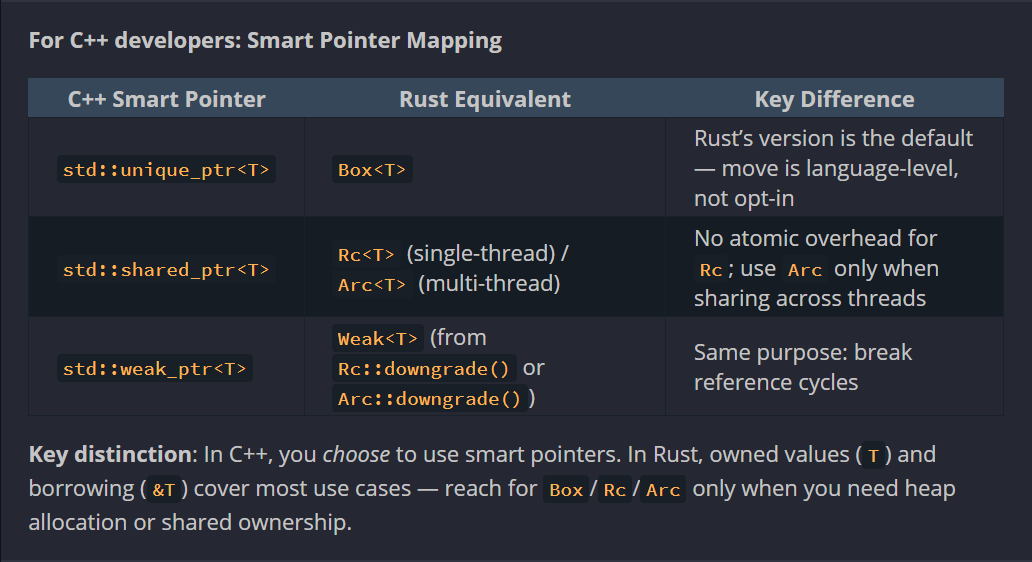
Shared Ownership: Rc Rc: Reference Counted(Atomic Reference Counted,原子引用计数)
允许不可变数据的引用计数共享所有权
use std::rc::Rc;#[derive(Debug)] struct Employee {employee_id: u64 }fn main () { let mut us_employees = vec! []; let mut all_global_employees = vec! []; let employee = Employee { employee_id: 42 }; let employee_rc = Rc::new (employee); us_employees.push (employee_rc.clone ()); all_global_employees.push (employee_rc.clone ()); let employee_one = all_global_employees.get (0 ); for e in us_employees { println! ("{}" , e.employee_id); } println! ("{employee_one:?}" ); }
指针类型
所有权模式
线程安全
是否可修改
Box
独占所有权
是
是
Rc
共享所有权(单线程)
否
否(需加 RefCell)
Arc
共享所有权(多线程)
是
否(需加 Mutex/RwLock)
Breaking Reference Cycles with Weak 用weak打破循环引用
use std::rc::{Rc, Weak};struct Node { value: i32 , parent: Option <Weak<Node>>, } fn main () { let parent = Rc::new (Node { value: 1 , parent: None }); let child = Rc::new (Node { value: 2 , parent: Some (Rc::downgrade (&parent)), }); if let Some (parent_rc) = child.parent.as_ref ().unwrap ().upgrade () { println! ("Parent value: {}" , parent_rc.value); } println! ("Parent strong count: {}" , Rc::strong_count (&parent)); }
总结
智能指针类型
所有权模式
线程安全
是否可修改
主要用途
Box<T>独占所有权
是
是
用于堆分配内存,适合递归类型、特征对象等。
Rc<T>共享所有权(单线程)
否
否(需加 RefCell)
单线程环境下的引用计数,用于不可变数据的共享所有权。
Arc<T>共享所有权(多线程)
是
否(需加 Mutex/RwLock)
多线程环境下的引用计数,用于不可变数据的共享所有权。
RefCell<T>独占所有权(内部可变性)
否
是
运行时借用检查,允许在不可变引用下进行可变操作(单线程)。
Cell<T>独占所有权(内部可变性)
否
是
提供内部可变性,适用于 Copy 类型,避免引用。
Mutex<T>独占所有权
是
是
提供线程间的互斥锁,确保数据在多线程环境下的安全修改。
RwLock<T>独占所有权
是
是
提供读写锁,允许多个线程同时读取或一个线程写入。
Weak<T>弱引用(避免循环引用)
是(配合 Arc)
否
配合 Rc 或 Arc 使用,避免循环引用导致内存泄漏。
Cow<T>借用或拥有
是
否
用于高效的只读操作,支持在需要时进行克隆以获得所有权。
Pin<T>固定内存位置
是
否
用于确保数据在内存中的位置不会改变,常用于异步编程。
Crates dependencies and SemVer At least 0.10.0, but anything < 0.11.0 is fine [dependencies] rand = { version = "0.10.0" }
Only 0.10.0, and nothing else [dependencies] rand = { version = "=0.10.0" }
Don’t care; cargo will select the latest version [dependencies] rand = { version = "*" }
Build Profiles: Controlling Optimization profiles
C/GCC Flag
Cargo.toml Key
Values
-O0 / -O2 / -O3opt-level0, 1, 2, 3, “s”, “z”
-fltoltofalse, “thin”, “fat”
-g / no -gdebugtrue, false, “line-tables-only”
strip commandstrip“none”, “debuginfo”, “symbols”, true/false
—
codegen-units1 = best opt, slowest compile
opt-level
0: 无优化
1:轻量优化
2:平衡优化
3:最大化性能
“s”: 减小二进制文件的大小(优化运行时性能的同时尽量减小生成的二进制文件的大小)
“z”: 优化完全偏向于减小文件大小,可能会牺牲部分运行时性能
opt-level
优化目标
编译速度
运行时性能
二进制大小
适用场景
0
无优化
最快
最慢
最大
开发和调试阶段
1
轻量优化
较快
较慢
较大
性能测试或快速开发
2
平衡优化
中等
快
中等
生产环境的默认选择
3
最大化性能
最慢
最快
较大
高性能计算或实时系统
“s”
减小二进制文件大小
中等
较快
较小
嵌入式开发或存储空间有限的场景
“z”
极限压缩二进制文件大小
中等
较慢
最小
微控制器或极端存储受限的场景
[profile.dev] opt-level = 0 debug = true [profile.release] opt-level = 3 lto = "fat" strip = true codegen-units = 1 panic = "abort"
cargo build cargo build --release
Build Scripts (build.rs): Linking C Libraries c/cxx源码在项目 You can even compile C source files directly from a Rust crate
添加构建依赖 ... [build-dependencies] cc = "1"
fn main () { cc::Build::new () .file ("src/c_helpers/ipmi_raw.c" ) .include ("/usr/include/bmc" ) .compile ("ipmi_raw" ); println! ("cargo::rerun-if-changed=src/c_helpers/ipmi_raw.c" ); }
链接已存在的库 在 crate 根目录使用 build.rs 文件:
fn main () { println! ("cargo::rustc-link-lib=bmc_ipmi" ); println! ("cargo:rustc-link-lib=stdc++" ); println! ("cargo::rustc-link-search=/usr/lib/bmc" ); println! ("cargo::rerun-if-changed=wrapper.h" ); }
Cross-Compilation rustup target add aarch64-unknown-linux-gnu cargo build --target aarch64-unknown-linux-gnu --release
在 .cargo/config.toml 中指定链接器:
[target.aarch64-unknown-linux-gnu]
linker = "aarch64-linux-gnu-gcc"
C Cross-Compile
Rust Equivalent
apt install gcc-aarch64-linux-gnurustup target add aarch64-unknown-linux-gnu + 安装对应的链接器
CC=aarch64-linux-gnu-gcc make.cargo/config.toml 中 [target.X] linker = "..."
#ifdef __aarch64__#[cfg(target_arch = "aarch64")]
Separate Makefile targets
cargo build --target ...
trait 特征 pub trait Summary { fn summarize (&self ) -> String ; }
特征只定义行为看起来是什么样的,而不定义行为具体是怎么样的. 只定义特征方法的签名,而不进行实现,此时方法签名结尾是 ;,而不是一个 {}。
impl Trait : 只是一个语法糖
使用特征作为函数参数 pub fn notify (item: &impl Summary ) { println! ("Breaking news! {}" , item.summarize ()); }
trait bound特征约束形如 T: Summary 被称为特征约束。
pub fn notify <T: Summary>(item: &T) { println! ("Breaking news! {}" , item.summarize ()); }
多重约束 pub fn notify (item: &(impl Summary + Display)) {}pub fn notify <T: Summary + Display>(item: &T) {}
Where 约束 当特征约束变得很多时,函数的签名将变得很复杂
fn some_function <T: Display + Clone , U: Clone + Debug >(t: &T, u: &U) -> i32 {}
使用where约束改进
fn some_function <T, U>(t: &T, u: &U) -> i32 where T: Display + Clone , U: Clone + Debug {}
函数返回中的 impl Trait 可以通过 impl Trait 来说明一个函数返回了一个类型,该类型实现了某个特征:
fn returns_summarizable () -> impl Summary { Weibo { username: String ::from ("sunface" ), content: String ::from ( "xxx" , ) } }
这种 impl Trait 形式的返回值,在一种场景下非常非常有用,那就是返回的真实类型非常复杂,你不知道该怎么声明时(毕竟 Rust 要求你必须标出所有的类型),此时就可以用 impl Trait 的方式简单返回。例如,闭包和迭代器就是很复杂,只有编译器才知道那玩意的真实类型,如果让你写出来它们的具体类型,估计内心有一万只草泥马奔腾,好在你可以用 impl Iterator 来告诉调用者,返回了一个迭代器,因为所有迭代器都会实现 Iterator 特征
但是这种返回值方式有一个很大的限制:只能有一个具体的类型,例如:
fn returns_summarizable (switch: bool ) -> impl Summary { if switch { Post { title: String ::from ( "Penguins win the Stanley Cup Championship!" , ), author: String ::from ("Iceburgh" ), content: String ::from ( "The Pittsburgh Penguins once again are the best \ hockey team in the NHL." , ), } } else { Weibo { username: String ::from ("horse_ebooks" ), content: String ::from ( "of course, as you probably already know, people" , ), } } }
通过 derive 派生特征 形如 #[derive(Debug)] 的代码
这种是一种特征派生语法,被 derive 标记的对象会自动实现对应的默认特征代码,继承相应的功能。
但是在实际项目中,往往需要对我们的自定义类型进行自定义的格式化输出,以让用户更好的阅读理解我们的类型,此时就要为自定义类型实现 std::fmt::Display 特征:
#![allow(dead_code)] use std::fmt;use std::fmt::{Display};#[derive(Debug,PartialEq)] enum FileState { Open, Closed, } #[derive(Debug)] struct File { name: String , data: Vec <u8 >, state: FileState, } impl Display for FileState { fn fmt (&self , f: &mut fmt::Formatter) -> fmt::Result { match *self { FileState::Open => write! (f, "OPEN" ), FileState::Closed => write! (f, "CLOSED" ), } } } impl Display for File { fn fmt (&self , f: &mut fmt::Formatter) -> fmt::Result { write! (f, "<{} ({})>" , self .name, self .state) } } impl File { fn new (name: &str ) -> File { File { name: String ::from (name), data: Vec ::new (), state: FileState::Closed, } } } fn main () { let f6 = File::new ("f6.txt" ); println! ("{:?}" , f6); println! ("{}" , f6); }
特征对象 可以使用特征对象来代表泛型或具体的类型。
trait Draw { fn draw (&self ) -> String ; } impl Draw for u8 { fn draw (&self ) -> String { format! ("u8: {}" , *self ) } } impl Draw for f64 { fn draw (&self ) -> String { format! ("f64: {}" , *self ) } } fn draw1 (x: Box <dyn Draw>) { x.draw (); } fn draw2 (x: &dyn Draw) { x.draw (); } fn main () { let x = 1.1f64 ; let y = 8u8 ; draw1 (Box ::new (x)); draw1 (Box ::new (y)); draw2 (&x); draw2 (&y); }
鸭子类型(duck typing) 只关心值长啥样,而不关心它实际是什么: 当一个东西走起来像鸭子,叫起来像鸭子,那么它就是一只鸭子,就算它实际上是一个奥特曼,也不重要,我们就当它是鸭子
特征对象的动态分发 dynamic dispatch 泛型是在编译期完成处理的:编译器会为每一个泛型参数对应的具体类型生成一份代码,这种方式是静态分发(static dispatch),因为是在编译期完成的,对于运行期性能完全没有任何影响。dyn 正是在强调这一“动态”的特点。
特征对象的限制 对象安全的特征 不是所有特征都能拥有特征对象,只有对象安全的特征才行。当一个特征的所有方法都有如下属性时,它的对象才是安全的:
方法的返回类型不能是 Self
方法没有任何泛型参数
对象安全对于特征对象是必须的,因为一旦有了特征对象,就不再需要知道实现该特征的具体类型是什么了。如果特征方法返回了具体的 Self 类型,但是特征对象忘记了其真正的类型,那这个 Self 就非常尴尬,因为没人知道它是谁了。但是对于泛型类型参数来说,当使用特征时其会放入具体的类型参数:此具体类型变成了实现该特征的类型的一部分。而当使用特征对象时其具体类型被抹去了,故而无从得知放入泛型参数类型到底是什么。
标准库中的 Clone 特征就不符合对象安全的要求:
pub trait Clone { fn clone (&self ) -> Self ; }
关联类型 关联类型是在特征定义的语句块中,声明一个自定义类型,这样就可以在特征的方法签名中使用该类型:
pub trait Iterator { type Item ; fn next (&mut self ) -> Option <Self ::Item>; }
完全限定语法 完全限定语法是调用函数最为明确的方式
<Type as Trait>::function (receiver_if_method, next_arg, ...);
特征定义中的特征约束 有时,我们会需要让某个特征 A 能使用另一个特征 B 的功能(另一种形式的特征约束),这种情况下,不仅仅要为类型实现特征 A,还要为类型实现特征 B 才行,这就是基特征( super trait )
use std::fmt::Display;trait OutlinePrint : Display { fn outline_print (&self ) { let output = self .to_string (); let len = output.len (); println! ("{}" , "*" .repeat (len + 4 )); println! ("*{}*" , " " .repeat (len + 2 )); println! ("* {} *" , output); println! ("*{}*" , " " .repeat (len + 2 )); println! ("{}" , "*" .repeat (len + 4 )); } }
和特征约束非常类似,都用来说明一个特征需要实现另一个特征,这里就是:如果你想要实现 OutlinePrint 特征,首先你需要实现 Display 特征。
Vector 常见的一些方法示例 let mut v = vec! [1 , 2 ];assert! (!v.is_empty ()); v.insert (2 , 3 ); assert_eq! (v.remove (1 ), 2 ); assert_eq! (v.pop (), Some (3 )); assert_eq! (v.pop (), Some (1 )); assert_eq! (v.pop (), None ); v.clear (); let mut v1 = [11 , 22 ].to_vec (); v.append (&mut v1); v.truncate (1 ); v.retain (|x| *x > 10 ); let mut v = vec! [11 , 22 , 33 , 44 , 55 ];let mut m : Vec <_> = v.drain (1 ..=3 ).collect (); let v2 = m.split_off (1 );
Testing Patterns and Strategies 注释和文档 闭包

 支付宝
支付宝